Bhaddiya Review Portal
After our seven-stage verification process completes, real people read the book — sentence by sentence. The Bhaddiya Review Portal is a purpose-built web application that puts native-speaker reviewers inside each translation, with tools to flag issues, propose corrections, and proof the audio before any edition ships.
The Review Process
Every edition is assigned to a native-speaker reviewer who works through the book at sentence granularity. Issues are categorized, logged, and fed back into the translation and scoring system.
Assigned reviewer gets a secure login to the portal for their specific language edition. Each session is tracked and logged.
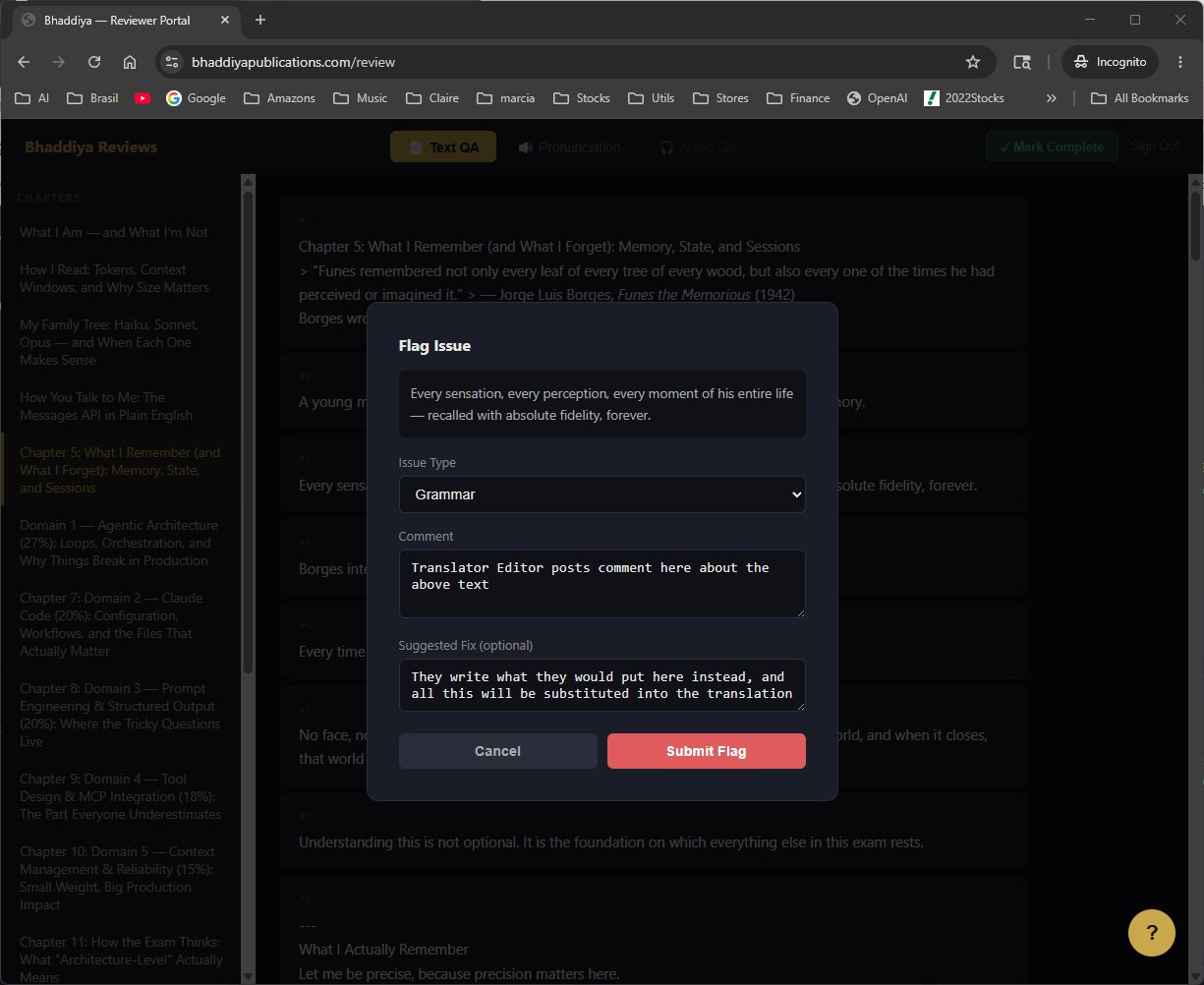
The full book is broken into chapters, each with numbered sentence segments. The reviewer works through at whatever pace suits them.
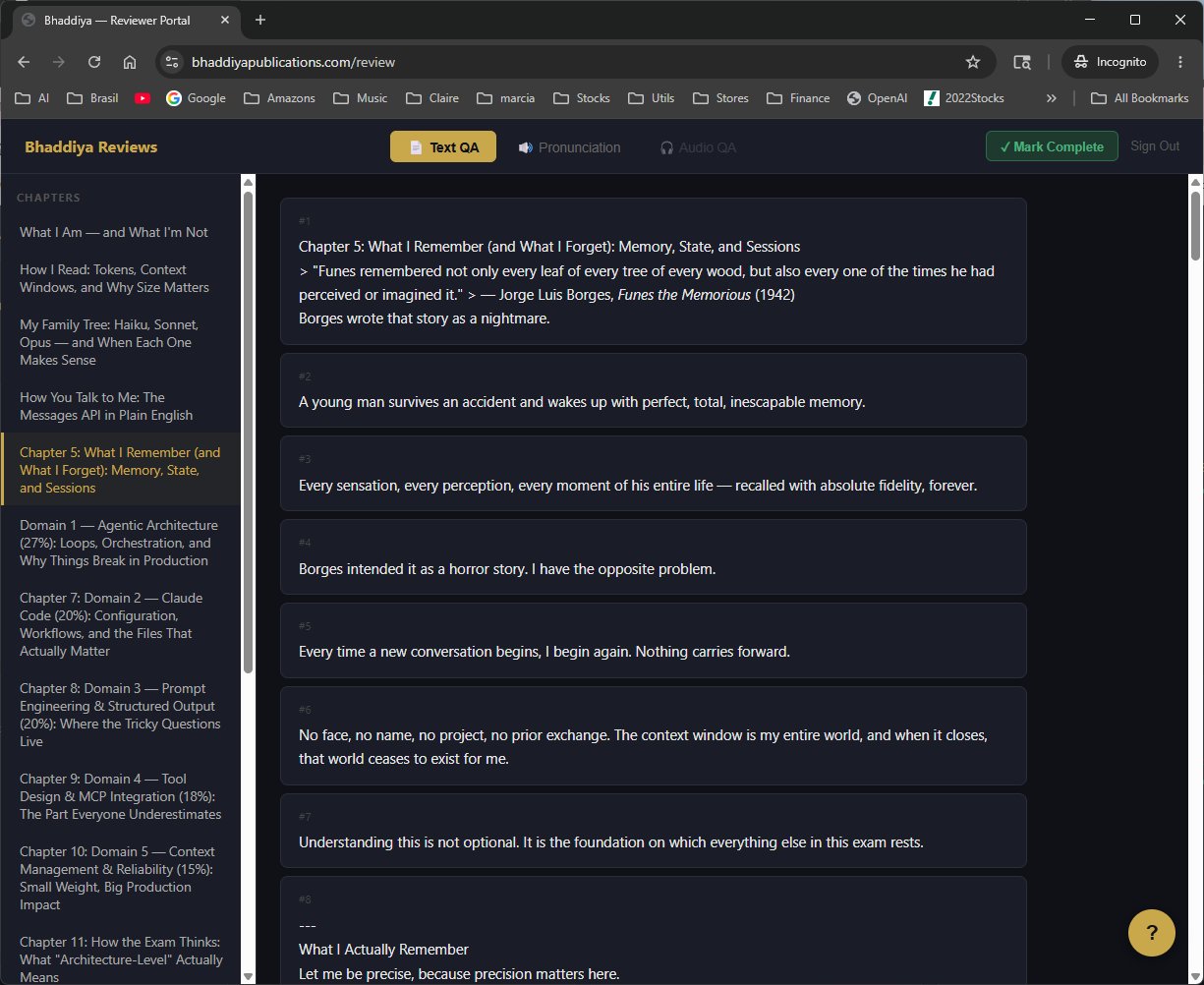
Click any sentence segment to open the Flag Issue dialog. Select the issue type, write a comment, and optionally provide a suggested fix.
Submitted flags are stored and scored. Each suggested fix can be incorporated into the translation directly. Flags also feed our data science layer — patterns across reviewers and languages improve how we handle similar issues in future editions.
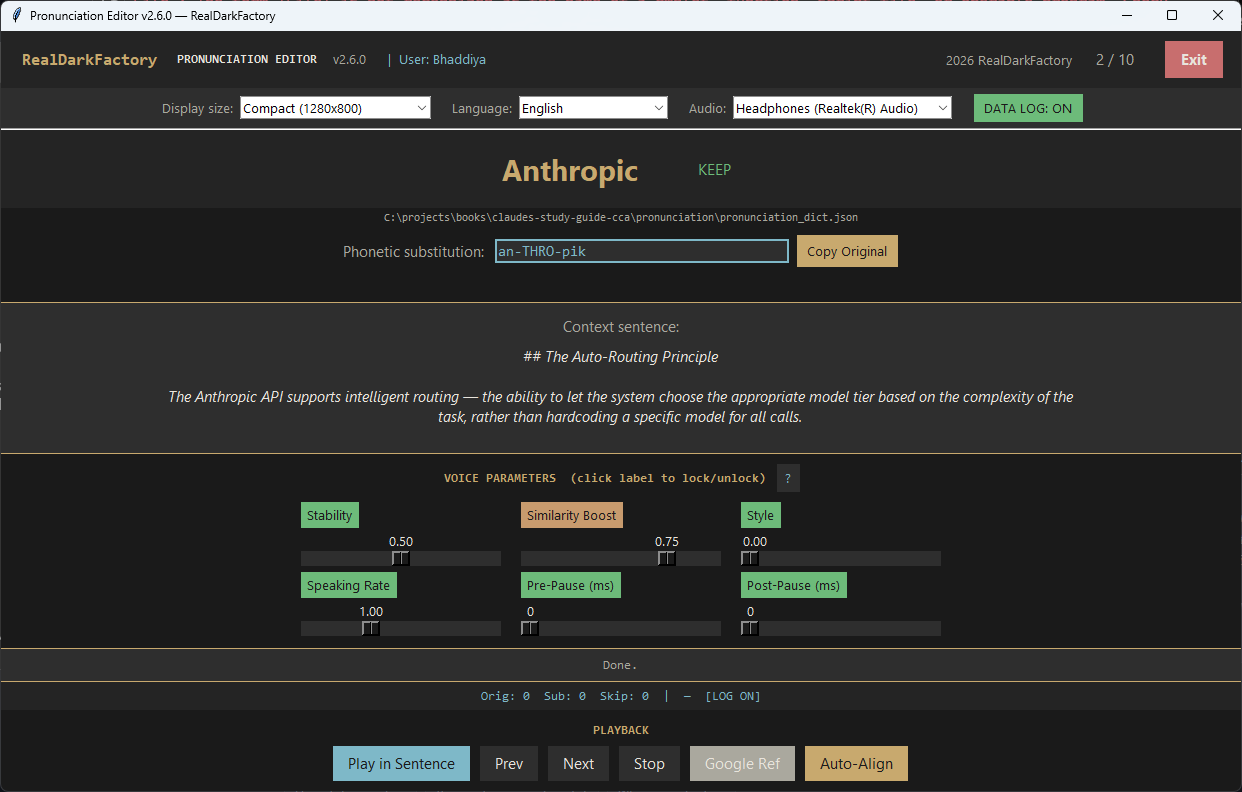
Switch to Pronunciation mode to listen to the AI-narrated audio. Flag pronunciation issues by segment for correction before release.
When satisfied, the reviewer marks the chapter complete. The final QA status is logged and the edition advances to packaging.
Feature: Text QA
The Text QA view presents each chapter as numbered sentence segments — not a wall of text. Every sentence in the translation is individually addressable, so reviewers can pinpoint exactly what needs attention without losing context.
The chapter navigation panel on the left lets reviewers jump directly to any chapter in the book. The active chapter is highlighted and a progress indicator shows which chapters have been reviewed.
Feature: Flag Issue
Clicking any sentence segment opens the Flag Issue panel. The reviewer sees the exact text being flagged, selects an issue category (Grammar, Accuracy, Terminology, Style, Fluency, and more), writes a comment, and — crucially — can provide a suggested replacement text.
Suggested fixes aren't just notes — they're structured replacements that can be applied directly to the translation file. This closes the loop between human review and the published edition.
Feature: Pronunciation & Audio QA
This is particularly important for technical vocabulary — AI model names, acronyms, proper nouns, and borrowed foreign words all have pronunciation edge cases that text-to-speech systems get wrong in predictable ways. Our pronunciation dictionary flags high-risk words before they ever reach the reviewer's ear, and improves with every book we complete.
Pronunciation data is one of the clearest examples of our data science loop at work — every reviewer correction refines the dictionary, every dictionary improvement benefits every future edition in that language.
Reviewer Program
We work with native-speaker reviewers for each language edition. If you're fluent in a language we publish and interested in contributing to the review process, we'd like to hear from you.
Work through a language edition at the sentence level, flagging translation issues and proposing corrections. Reviewers work asynchronously at their own pace via the web portal.
Czech · Slovak · Lithuanian · Estonian · Korean · Arabic · Japanese — and all upcoming languages. Native fluency required; technical background helpful but not mandatory.
Email us with your native language, any technical background, and a brief note about yourself. We'll be in touch about the review process and compensation.